
Every supplier on Alibaba describes itself as a manufacturer. Many of them are trading companies: businesses that take your order and place it with a factory you never see. That isn’t fraud, and it isn’t always bad. But it changes the price you pay, how quickly problems get fixed, and how much control you have over what is made.
You can usually tell which you are dealing with inside a day, using the business licence, a few questions and one video call.
Why it matters
A trading company sits between you and production. That brings three costs:
- A margin on top of the factory price.
- A slower loop. Your questions go through another set of people, often in another city, before they reach the production line.
- Less control. You can’t easily inspect during production, talk to the engineer or move your tooling, because you don’t know where the work happens. Some trading companies also move orders between factories to chase price, so your second order may come from somewhere new.
It also brings benefits, covered below. The point is to know what you are buying.
Seven signs that tell them apart
| Sign | Factory | Trading company |
|---|---|---|
| Business scope on the licence | Production or manufacturing (生产, 制造, 加工) of your product type | Sales (销售), wholesale (批发), import and export (进出口) only |
| Company name | Often ends in industrial (工业), manufacturing (制造) or electronics (电子) | Often contains trading (贸易, 商贸) or import and export (进出口) |
| Registered address | Industrial zone, often outside the city centre | Office tower or business park in the city |
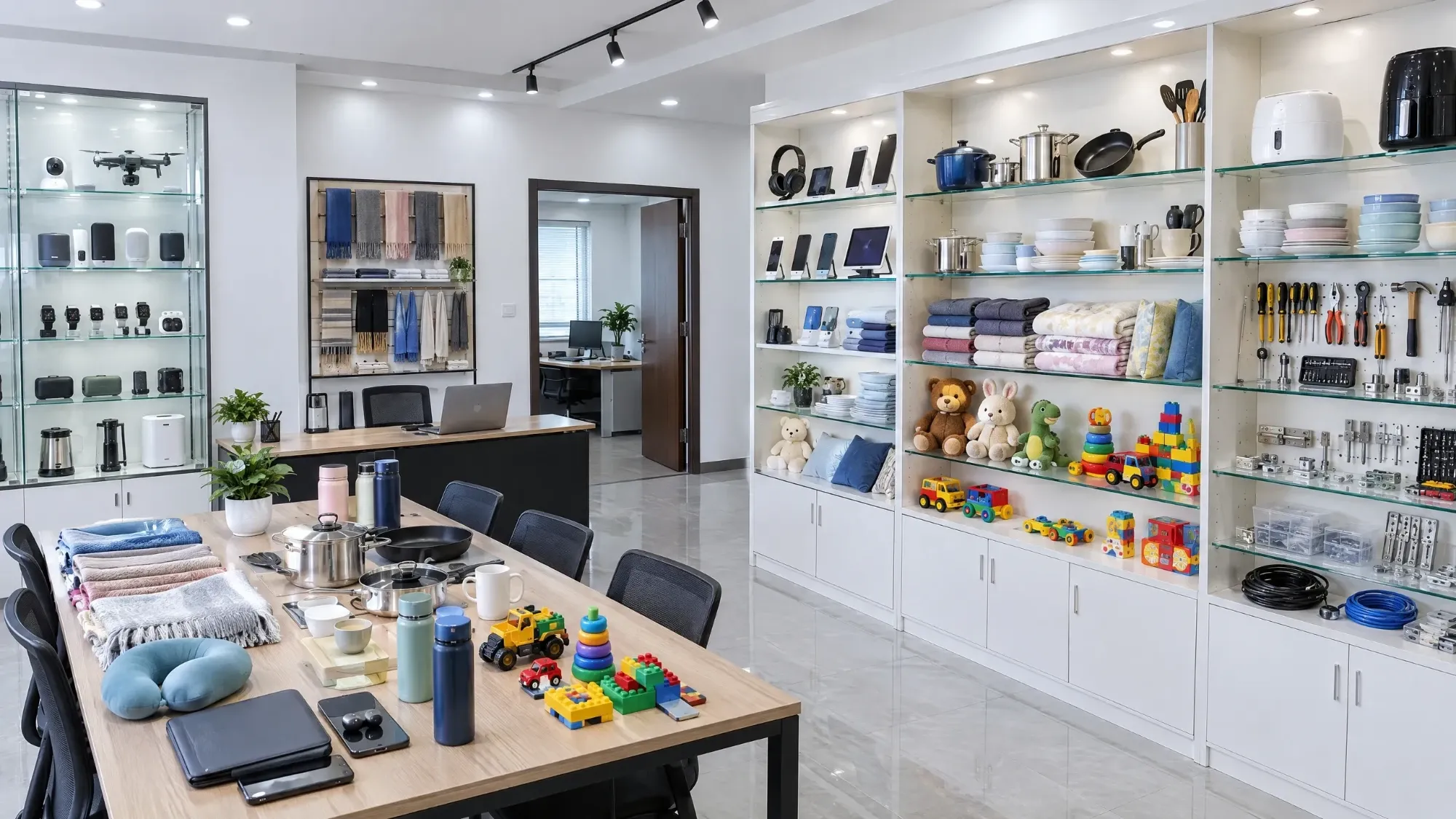
| Product range | Deep in one category: many variations of similar products | Wide and unrelated: kitchenware, toys and phone cases from one supplier |
| Technical answers | Talks about materials, moulds, machine time and process limits | Says “we’ll check with the factory” or gives general answers |
| Pricing | Breaks down by material and process; MOQ tied to the production run | Flat unit prices; low MOQs on many products |
| Visit or video | Production floor available on short notice | Showroom, office or a factory it “works closely with” |
No single sign proves it. A factory in a fast-growing city may sit in a business park, and plenty of factories hold an export licence through a trading arm. Look for several signs pointing the same way.
The questions that get a straight answer
Ask these by email, so you have the answers in writing:
- “Which products on your list do you make in your own factory?” A factory will name them. A trading company often says “all of them”.
- “What machines do you use for this product, and how many?” Injection moulding machines and their tonnage, sewing lines, CNC centres. Specific numbers are a good sign.
- “Can you show me the production line on a video call now?” Not a pre-recorded tour. Live, today.
- “What is the full address of the factory, and is it the address on your business licence?”
- “If we pay for tooling, where will the mould be kept, and can we move it?”
When a trading company is the better choice
A capable trading company can be the right partner when:
- you need small quantities of many products that no single factory makes;
- the factory’s minimum order is higher than you can carry;
- you want one contact, one contract and one shipment across several factories;
- the trading company has strong quality control and will tell you which factory it uses.
The best trading companies are open about their factories and let you inspect at the source. Be wary of the ones that won’t.
Factories with a trading arm
Many factories run a separate trading company, often in the same building, to handle exports or to sell products from neighbouring factories. That is normal. Check both company records on the national registry, sign the contract with the company that will make your goods, and pay that company’s corporate account. Our guide to verifying a Chinese supplier shows how.
The bottom line
Read the business scope on the licence first; it is the quickest and most reliable sign. Then check the address, the product range and who answers the technical questions, and ask for a live video call from the production floor. Choose a trading company on purpose when its service is worth the margin, not by accident. Either way, write tooling ownership, the production address and inspection rights into your contract.
Our product sourcing team works directly with factories and tells you which factory makes your order. Send us a brief to start.
Questions we get asked
How can I tell if an Alibaba supplier is a factory?
Ask for the business licence and check whether the business scope includes production of your product type, then compare the registered address with the factory address. Ask a technical question about materials or tooling and see who answers. A video call from the production floor, unprepared, settles most doubts.
Are trading companies more expensive than factories?
Usually, because they add a margin on top of the factory price. Sometimes they are not, because a good trading company buys in volume across many clients or has negotiated better terms. Compare total cost, including your time managing the supplier and the cost of quality problems.
When is a trading company the better choice?
When you need small quantities across many different products, when the factory's minimum order is too high, or when you want one supplier to manage several factories for you. A capable trading company is a better partner than a factory that ignores small buyers.
Can a factory also be a trading company?
Yes. Many factories run a separate trading company for export, or sell products from neighbouring factories alongside their own. Ask which items they make themselves and which they buy in.
Do trading companies hide which factory makes the goods?
Often, because the factory is their main asset. That makes it harder for you to control quality, inspect during production or move the tooling if something goes wrong. If you pay for moulds, make sure the contract says you own them and names where they are.